
Water availability is becoming an increasingly important consideration for growers, but choosing a substrate with the highest water-holding capacity is not necessarily the answer. Botanicoir’s Sales Manager for Europe and the Middle East, Krzysztof Sak, explains how efficient water use depends on how effectively the crop can access that water, alongside maintaining the right balance of air, water and EC in the root zone.
Water is becoming one of the most important resources in modern horticulture. With increasing pressure on water availability, rising temperatures and a greater focus on sustainable production, growers are understandably looking for ways to reduce water use.
This often leads to a simple assumption:
If a substrate holds more water, we will need to irrigate less and therefore use less water.
But water efficiency is not simply about how much water a substrate can store. The real question is how effectively that stored water can be accessed and used by the crop.
Growing media specialist and Botanicoir partner, Legro, has a well-known mantra. “You can always bring water to the plant, but it is much more difficult to get water out”.
Water storage is not the same as water efficiency
Water Holding Capacity (WHC) tells us how much water a substrate can retain. It does not tell us how efficiently that water will be used by the crop.
The objective should not necessarily be to store the maximum possible amount of water in the root zone. Instead, the focus should be on maintaining the right balance between water availability, air content and irrigation control.
Roots need water, but they also need oxygen.
When a substrate remains too wet for too long, the amount of air available in the root zone can decrease. This can affect root activity and potentially limit the ability of the root system to explore and efficiently use the full substrate volume.
Growing media specialist and Botanicoir partner, Legro, has a well-known mantra. “You can always bring water to the plant, but it is much more difficult to get water out”.
A substrate containing more water does not automatically mean a crop is using water more efficiently.
Supporting the root system
A healthy and active root system is one of the most important parts of efficient water management.
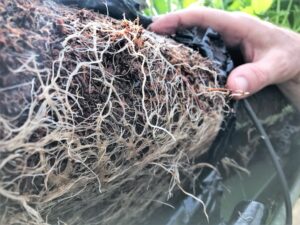
We want roots to develop throughout the substrate, rather than being concentrated only in certain areas. Good water distribution combined with sufficient air space encourages the plant to explore the available substrate volume.
This means we should not only ask:
“How much water can this substrate hold?”
We should also ask:
“How effectively can the roots access and use the water within it?”
That distinction is important because the goal is not simply to create a larger reservoir of water. It is to create a root-zone environment where the crop can make effective use of the water available.
Irrigation should replace what the plant uses
The substrate acts as a buffer between irrigation events and plant uptake.
The plant’s water demand is driven largely by factors such as radiation, temperature, humidity, plant size and transpiration. A higher WHC does not make this demand disappear.
Instead of simply trying to create the largest possible water reservoir, modern irrigation strategies should focus on supplying water according to plant demand while maintaining stable conditions in the root zone.
A substrate with a good balance between water and air gives growers greater opportunity to manage irrigation dynamically, responding to changing conditions rather than simply keeping the root zone wet.
Drainage is part of the discussion too
Water efficiency is also about what happens to the water after it enters the substrate.
Uniform water distribution, appropriate irrigation volumes and good control of EC can help avoid unnecessary irrigation and excessive drainage.
At the same time, trying to eliminate drainage completely can create another problem. Salts can accumulate in the root zone, particularly during periods of high transpiration.
Once again, the answer is balance and control, rather than simply using less water.
From water holding to water management
Perhaps we need to change the way we think about substrates.
Instead of asking:
“Which substrate holds the most water?”
we should be asking:
“Which substrate gives us the best control over water, air and EC throughout the day and throughout the season?”
Because conserving water does not simply mean giving plants less. It means making every litre count.