

The Summer Berry Company (TSBC) has recently announced that it is able to offer year-round Strawberry production, lengthening the season by five months.
The transition to this new model has begun, with plans to develop a ‘Green Energy Solution’ (GES). This will reduce the site’s reliance on fossil fuels, incorporating a Combined Heat and Power (CHP) plant, a state-of-the-art combined water/air source heat pump, a site-wide heat network and LED lighting on the glasshouses.
Once it is operational, the GES will reduce the overall spend on energy by around 40%, cut CO2 emissions by 20%, and allow the site to provide extensive additional lighting to the crop in winter.
“We’re aiming to achieve net zero by 2030, and we are looking at a number of sustainability initiatives across the farm,” explains head of growing at TSBC Micky Riggs.
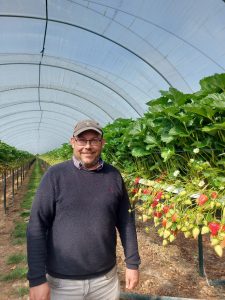
“We have state-of-the-art glasshouses which we’re using to grow strawberries on gutter swing systems, meaning we can increase plant density per hectare and manoeuvre the gutters when we come to harvest,” he says.
“We will soon have a unique LED system in place ready for planting in late summer. Combined with the GES, this will enable us to produce delicious strawberries throughout the late autumn and winter and into spring next year.”
TSBC grows strawberries, blueberries and blackberries in the UK, with a mix of field and glasshouse production with its Portugal operation mainly focusing on Raspberry production.
Among the innovations being employed by TSBC in both countries is robot harvesting and forecasting. Micky explains how this works in the UK, “The robots pick in the glasshouse and the field, and while they have significantly improved over the years, they still have a way to go in terms of fully replacing humans.
“Due to the complexity of the fruit presentation, it currently still requires people to go in afterwards and pick the berries that have been missed. But they are learning as they pick using Artificial Intelligence, and they will continue to improve.”
The company also uses ‘UV robots’ to apply ultraviolet light to the strawberries to tackle powdery mildew – the number one disease in strawberries.
“Alongside the UV treatment we also try to use biological controls as much as possible, as part of a more sustainable approach to growing. We utilise ‘bio-applicator’ machines and this year two machines are out in the fields requiring only one driver each, resulting in very timely applications and a reduction in labour required for this critical job,” says Micky.
Producing around 7,000 tonnes of fruit annually in the UK, and supplying all major UK supermarkets means that quality, yield, and optimising timing is key for Micky.
“We produce around 750 tonnes of blueberries and over 6,000 tonnes of strawberries, with ambitions to grow more as part of our year-round supply. We also produce a small of amount of blackberries and are carrying out multiple varietal trials with a view to expanding production in the future,” says Micky.
“Pinch points, where we don’t want too much fruit production are often the middle of June and also during August, when people are on holiday, so control and steerability of the crops is really important.”
成长媒体
TSBC has worked with coco coir producer, Botanicoir, for over 10 years, and says the consistency of the product is key to supplying UK supermarkets. “Consistency in terms of coir quality is critical.
“Botanicoir consistently delivers quality and there is not a year when this isn’t the case, it’s always the same and as a grower this is really important,” says Micky.
TSBC started using Botanicoir products on raspberries and they were the only supplier at that time who could meet the bespoke requirement. “I was after a very particular type of substrate and I didn’t want any fines below 2mm in the mix, so anything below this size was removed and the mix had to be very free draining.
“We had great success with it, so we also transitioned it on the strawberries in our tunnels and we haven’t looked back,” explains Micky.
The consistency of the coir will be crucial when the year-round strawberry growing is in full swing. “Steerability in the higher-pressure season is paramount,” says Micky.
The team is also trialling recycling the coir. “At the end of the crop’s life, we shred all the plant material, and the waste coir is taken off to be sterilised and sent back for us to re-use.
“We have successfully trialled smaller areas over the previous two years, with different varieties of Strawberries. So far, so good, the yields are on a par with normal yields, but we need to extend the trials further in order to use it on a commercial level across the farm.”
The future
Plans for fruit expansion in the UK are afoot, alongside the year-round strawberry production. “We’re converting some of our old raspberry fields into strawberry fields to maximise our utilisation of area in our field cropping systems,”
“The mix of the state-of-the-art glasshouse growing with renewables and LED lights, combined with field-growing will help us move to 12 months of UK production, and then it’s about optimisation,” adds Micky.