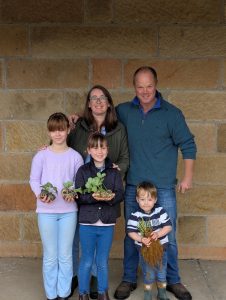

Nestled in the heart of Tasmania’s Ouse region, Jack and Lisa Beattie’s 280-hectare farm is a testament to resilience, adaptability, and agricultural innovation. The farming venture has evolved into a thriving strawberry nursery plant operation, supplying millions of high-quality plants to growers across Australia. With a strategic mix of bare root and plug plant production, Jack’s farm is at the forefront of the rapidly expanding berry sector.
A journey from dairy to berries
Originally from the UK, Jack started his farming career in the dairy sector before relocating to Tasmania to pursue new opportunities. Alongside working in the Tasmanian dairy sector – where his family bought a dairy farm, as well as doing some consultancy work – he purchased 80-hectares of land, which has become part of the 280-hectare farm he operates today. The dairy farm has now been sold and Jack sees a future in berry propagation growing.
The shift from dairy to strawberry plant production was a bold one. Initially approached by a fruit marketing company to lease some of their land, the relationship evolved into Jack and Lisa getting their own propagation licences and working in conjunction with proprietary genetics owners with contract propagation.
Strawberry plant production: scaling up
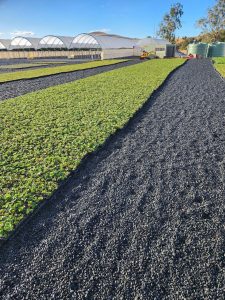
Today, Jack and Lisa’s farm produces between 5 to 10 million strawberry plants annually, supplying every Australian state except the Northern Territory, where strawberries are not grown. The farm cultivates 16 strawberry varieties, including many proprietary types protected by breeding companies with intellectual property rights. These high-performing varieties are in demand across the country, with the farm helping to meet the increasing appetite for top-quality plants.
The production is divided into two key systems:
- Bare root strawberry production:
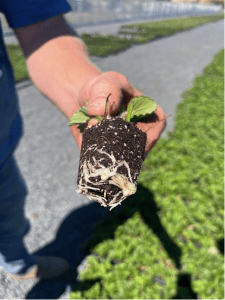
This traditional method involves growing plants directly in the soil. Bare root plants are ideal for large-scale commercial growers seeking hardy, robust plants with a strong root system.
- Plug plants and misted tips:
The misted tips are cultivated in Haygrove polytunnels on elevated table-tops using Precision Plus fully buffered coir grow bags from coco coir specialist, Botanicoir. The farm plans to switch to Botanicoir’s Precision Plus Ultra (PPU) grow bags next season, which are deeper, offering more space for root development, optimal drainage and potentially higher yields.
The farm’s plug plant production has seen rapid growth. “It’s our second season growing plug plants and the sector is growing at an alarming rate; our sales are expanding at 400% compounded per annum,” says Jack.
The misted tips are then transferred to plug trays filled with a Legro professional propagation substrate blend of peat, coir, and perlite. These trays are then moved outside for hardening off – a process that takes between 4 to 16 weeks, depending on the variety.
Exceptional results with premium growing media
One of the farm’s biggest success stories is its outstanding yield rates, thanks in part to the quality of the growing media. “We’ve had fantastic results with the growing media, for example, one of the proprietary varieties yielded 750 tips per bag and you don’t do that without having good material,” says Jack.
Jack works with Phil Badgery at substrate specialist, Legro. “Phil supplies us with Botanicor coco coir grow bags for the misted tips. “We need consistent growing media to deliver these results. For the best quality crop, we want the best bag and I’m confident that it is,” says Jack.
“We also use a bespoke Legro substrate mix containing coir, for the plug trays, which gives us a 98% grade rate,” he says. “This means that if we plant 100 tips, we successfully sell 98 of them.” This high success rate is a testament to the farm’s precision growing methods and careful attention to detail.
“Jack and Lisa have done a fantastic job expanding into strawberry tray and plug plant production, all while maintaining exceptional quality. It’s been fantastic to work with them to optimise their growing operations with quality growing media. I’m confident that Australia will continue evolving into a market driven not only by cost but also by yield and performance – and they are a prime example of that,” says Phil Badgery at Legro.
While strawberry plant production is the core of the operation, the farm also prioritises sustainability. Of the 280 hectares, 70 hectares are dedicated to regenerative agriculture and native grassland restoration.
Of the remaining area 150 hectares are used for forage production, primarily growing lucerne. This diversification helps balance the business and promotes soil health through crop rotation and sustainable farming practices.
Meeting the growing demand for strawberry plants
As the Australian berry industry continues to expand, the demand for high-quality strawberry plants is only increasing. Jack and Lisa Beattie’s farm is well-positioned to meet this growing need with a focus on innovation, efficiency, and premium plant quality.
“We hope to move to Botanicoir’s Precision Plus Ultra (PPU) bag next year, it drains a bit faster, which we hope means we can get better performance on some varieties,” he says.
By embracing cutting-edge growing techniques, investing in premium substrates, and maintaining a commitment to sustainability, Jack and his team have grown the strawberry propagation into a thriving business. With the plug plant sector booming and proprietary varieties in high demand, the future looks bright for this Tasmanian strawberry nursery.
Looking ahead
With ambitious plans for expansion and continuous improvement in their growing methods, Jack and Lisa Beattie’s Tasmanian farm is setting a new standard for strawberry plant production in Australia. Their focus on quality, sustainability, and innovation ensures they remain at the forefront of the country’s berry sector.
“It’s an expanding market and we are investing in growing our operations to meet the demand,” adds Jack.